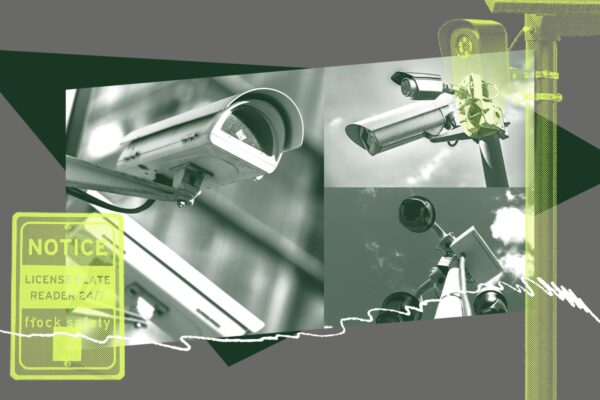
Wisconsin is finally starting to have a serious conversation about Flock and the enormous amount of information automated license plate readers (ALPRs) can collect about where people drive. Communities are questioning how long that information should be kept, who should be allowed to search it, whether police should need a warrant to access it, and what happens when officers misuse the technology.
But there is another company operating in Wisconsin that deserves just as much attention: Axon. And while it would be inaccurate to say that Axon is simply Flock with a different logo, it would also be a mistake to overlook the fact that Axon is building something much larger than an automated license plate reader company.
Axon sells body cameras, in-car cameras, automated license plate readers, drones, digital evidence systems, real-time crime center technology and artificial intelligence tools. Through its acquisition of Fusus, Axon is also building the infrastructure that can connect many of these different surveillance technologies together. That creates a fundamentally different concern: not simply what one camera can see, but what happens when an entire city becomes a network of cameras and sensors that police can access, search and analyze through one system.
Wisconsin Is Already Using Axon
This isn’t some hypothetical technology that might eventually arrive in Wisconsin. Police departments across the state are already using different pieces of Axon’s ecosystem.
Milwaukee uses Axon body cameras and other Axon technology and has also contracted with Fusus, the real-time surveillance platform Axon acquired in 2024. Wauwatosa uses Axon body cameras, while other Wisconsin communities including Grand Chute, Kenosha and Sun Prairie have adopted or considered different Axon technologies. Kenosha has moved from Flock toward Axon’s Outpost system, while Sun Prairie has considered Axon technology as it moves away from its Flock contract.
There are obvious administrative reasons for this. If a police department already uses Axon for body cameras and evidence management, adding Axon’s ALPRs, cameras or other products can make it easier to manage everything through one vendor instead of maintaining several systems that do not communicate with each other.
But what is convenient for a police department can also be incredibly powerful for a government agency trying to collect and analyze information about the people it polices.
Fusus
Fusus is probably the most important part of Axon’s ecosystem to understand. Axon describes Fusus as a “single pane of glass” that can bring different sources of information into one platform, including police body cameras, drones, in-car cameras, ALPRs, government cameras and privately owned cameras.
That means police do not necessarily have to own every camera in a city to gain access to a much larger surveillance network. A business can have a security camera, a university can have cameras, a city can have traffic cameras and a police department can have body cameras and drones, while Fusus can potentially bring information from those different systems into a common operating picture.
Imagine walking through a Wisconsin city. A private security camera records you walking past a business, a city camera captures you crossing an intersection, an ALPR records your vehicle, and a police vehicle’s camera captures you driving down the road. Later, you attend a political demonstration where police body cameras, drones, fixed cameras and cameras at nearby businesses are all recording.
None of those systems has to be pointed directly at you for them to collectively create an enormous amount of information about you. Connected together, those individual observations can begin to create a detailed record of where you went, when you were there and what was happening around you. Moreover, Axon can then use AI-powered analytics to predict your future movements.
The Danger Is Not One Camera. It Is the Network.
This is where the comparison to George Orwell’s 1984 starts to become difficult to ignore.
Orwell’s Big Brother was frightening not simply because cameras existed, but because surveillance became part of everyday life. People could never be certain when they were being watched, and the government possessed the ability to monitor and analyze the lives of ordinary people.
Police departments do not currently have the ability to watch every person at every moment. But modern technology is making something that once would have required an enormous government bureaucracy increasingly possible through commercial software.
A single camera gives the government one observation. A network gives the government a history. When those observations can be connected to locations, timestamps, vehicle information and other video, the government can potentially reconstruct far more about a person’s movements than any individual officer could observe by simply standing on a street corner.
And this is where Axon becomes different from Flock.
Flock’s central concern is that ALPR networks can create searchable records of where people’s vehicles have been. Axon is building technology that can potentially connect those records to body cameras, drones, street cameras, private cameras and other sources of information. The issue isn’t simply whether police can see your car. It is whether the government can eventually assemble a detailed picture of your movements from hundreds or thousands of separate observations.
AI Makes It Even More Dystopian
Artificial intelligence makes the scale of this problem different from anything police departments could have done a generation ago. A department might have thousands of hours of video, but historically a person still had to watch it.
Axon is developing AI tools that can help police search and analyze video and other evidence, while Fusus incorporates AI capabilities into its real-time surveillance platform. That means the question is increasingly not just whether police have access to a camera, but whether software can search enormous amounts of information collected across many different cameras and systems.
Think about what that could mean for a protest. Your vehicle could be recorded arriving by an ALPR. Your movements could be captured by public and private cameras. A drone could record the demonstration from above. A body camera could capture your interaction with an officer. Those pieces of information could potentially exist independently, or they could become part of a larger searchable system.
People should be able to attend a political demonstration, go to a specialist medical clinic, seek mental health support, visit a university, practice their religion, meet with an organizer or simply travel around their own community without assuming that every camera they encounter is contributing another piece of information to a government surveillance network.
We Should Be Asking What We’re Building
None of this means that every camera should be banned or that every Axon product has no legitimate law enforcement purpose. A body camera can document a police encounter. A drone can help locate a missing person. An ALPR can help locate a stolen vehicle. There are legitimate uses for many of these technologies.
The question is what happens when they become connected.
Who can access the information? How long is it retained? Can police search it without a warrant? Can one agency search another agency’s data? Can private cameras feed into government surveillance systems? Can artificial intelligence search thousands of hours of footage? What happens when an officer misuses the system? And what democratic oversight exists before a city becomes dependent on a privately operated surveillance infrastructure?
The authoritarian governments of the past could only dream of having this kind of technological capability. They needed enormous networks of police, informants and bureaucrats to monitor where people went and who they associated with. Today, cameras can collect information automatically, databases can store it indefinitely, and AI can increasingly help governments search through it.
Technology companies are making capabilities that once belonged to the realm of science fiction available to ordinary local police departments.
Flock has forced Wisconsin to ask whether we are comfortable with police departments creating searchable records of where people drive. Axon forces us to ask a much bigger question: what happens when those records become just one piece of a network capable of connecting cameras, drones, body cameras, private surveillance systems and artificial intelligence across an entire community?
The danger is not one camera.
It is the network.