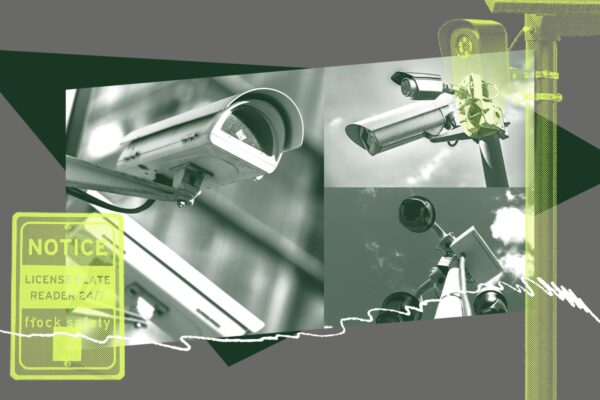
We've seen local governments step away from Flock contracts, and we've seen communities begin asking much bigger questions about whether police should have access to systems that can create a searchable record of people's movements in the first place.
But now we're starting to see something that deserves just as much attention: some communities are leaving Flock and moving to Axon.
Flock Is a Company. ALPR Is the Technology.
One of the biggest problems with the way we've talked about Flock is that Flock has become synonymous with automatic license plate readers (ALPRs), even though Flock is simply one company selling a particular type of AI-powered dragnet mass surveillance technology.
Flock sells ALPR systems. Axon sells ALPR systems. Other companies sell ALPR systems too.
It's basically the Kleenex problem. Kleenex is a brand of tissue, but we've gotten so used to the brand that people use the brand name to describe the product. Flock has become the name people use to describe a much broader category of surveillance technology.
That distinction matters because if what concerns us is that the government can use cameras to create a searchable record of where your car has been, switching from Flock to Axon does not make that underlying concern disappear.
If a city cancels Flock and replaces it with Axon ALPR, that is not a complete mass surveillance victory. It is a vendor change.
We Must End AI-Powered Mass Surveillance, Not Switch Vendors.
Sun Prairie is a good example. The city recently announced that it would not renew its Flock contract, with its existing cameras set to expire over the coming months, but the police department is now looking at moving to Axon's Outpost system instead. The city's explanation makes sense from an administrative perspective: Axon already provides other technology to the department, and consolidating different systems under one vendor can make it easier for police to manage their technology.
Kenosha has already shifted from Flock to Axon.
But from a privacy perspective, that raises a much bigger question.
Are we actually ending the surveillance, or are we just changing the company that provides it?
Because if we cancel Flock and replace it with another company that can still create a searchable record of where people's cars go, we haven't really answered the question that started this conversation.
Axon: Fully-Integrated Voyeurism
Axon is not simply Flock with a different name. Axon has built some controls around some of its ALPR data sharing, and those differences are important to note. But it would also be a mistake to ignore the fact that Axon is trying to build something much larger than an ALPR company.
Axon sells body cameras, digital evidence systems, Tasers, drones, ALPR technology, and real-time intelligence tools, and through its Fusus platform it can also help law enforcement integrate information from public and private camera networks and other sources.
That creates a different kind of concern.
A police department using one company for ALPR and another company for its body cameras, evidence systems, drones, and other surveillance technologies is not necessarily a perfect system of privacy, but there are at least different companies operating different pieces of the infrastructure. When one company increasingly provides the cameras, the evidence platform, the drones, the ALPR system, and the tools used to connect and search all of that information, we should be asking what happens when those systems become increasingly integrated.
What is convenient for a police department can also be incredibly powerful for a government agency trying to collect and analyze information about the people it polices.
The point is that we should be looking at the technology and the systems we're building, rather than treating the name of the company on the camera as the entire issue.
Don't Let Flock Become the Only Villain
This is the part I worry we're going to get wrong.
We should absolutely hold Flock accountable for the problems that have come to light. We should investigate police departments when officers misuse the technology, we should demand transparency about who can access these systems and what information is being shared, and we should be asking why a private company should be building a massive database of vehicle movements for government agencies in the first place.
But we should not let Flock become the villain in a way that allows the surveillance industry to survive simply by changing the logo on the camera.
The problem isn't that one surveillance company is bad.
The problem is that technology companies have made it increasingly easy for governments to collect, store, search, and share information about where people go, who they spend time with, what they look like and other private information; often on a scale that would have been difficult or impossible for police departments to achieve a generation ago.
That information can reveal incredibly sensitive things about someone's life without telling you anything about whether they've committed a crime.
It can show that someone went to an abortion clinic, a gender-affirming care provider, a church, a protest, a gun range, a friend's house, or the home of a romantic partner.
You don't need facial recognition for that information to be sensitive. You don't even need an officer to physically follow someone. You just need a camera, a database, and the ability to search it later.
We can’t let a decision to switch from one private surveillance company to another let these technologies off the hook. ALPR’s don’t need a marketing rebrand – they need to be banned.
Wisconsin Needs to Set the Rules
The good news is that people are starting to recognize that Flock raises serious questions about privacy and government power, and local governments are starting to listen.
But we shouldn't stop at getting rid of Flock.
We should make sure that Flock doesn't become the villain in a story where the surveillance industry gets to survive simply by changing the logo on the camera.
If local governments continue using this technology, the rules should not depend on whether a police department buys Flock, Axon, Motorola, or whatever company comes next.
That’s why we filed a petition directly with the Wisconsin Supreme Court asking that judicial warrants be required to query data collected by ALPRs.
Ultimately, all ALPRs should be banned. Although any protections we can win right now are sorely needed, local communities are playing whack-a-mole with these technologies.
No indiscriminate mass surveillance. No ALPRs. No excuses.