
Last week, the Wisconsin Supreme Court unanimously ruled the Minority Undergraduate Retention Grant Program unconstitutional.
The program, established by the legislature in 1985, provided grants from $250 to $2,500 for students of color based on financial need, with most going to Black MATC students.
This decision is another frustrating rollback of Civil Rights-era steps toward racial equity.
Affirmative Action Ended in 2023
SCOWI is following the lead of the Supreme Court of the United States, which has recently used the Fourteenth Amendment’s Equal Protection Clause for the opposite of its intended purpose.
In 2023, SCOTUS effectively eliminated the use of affirmative action in college admissions, setting a precedent that makes it harder to pursue relief and redress for racism.
This misuse of antidiscrimination law has been a tactic since the backlash to the Civil Rights Movement, flipping the script to reframe remedies for racial discrimination as themselves racially discriminatory.
Some SCOWI Justices Reluctant
The main opinion—written by Justice Annette Ziegler and joined by Justices Rebecca Bradley, Brian Hagedorn, and Janet Protasiewicz—argued that the grant program does not meet the strict requirements of race-conscious laws due to lack of evidence that students of color drop out of Wisconsin colleges at disproportionate rates or that “race-neutral alternatives cannot accomplish the same ends.”
In their concurring opinions, three justices agreed that this grant program specifically is unconstitutional but slammed SCOTUS’s ahistorical interpretation of the Fourteenth Amendment.
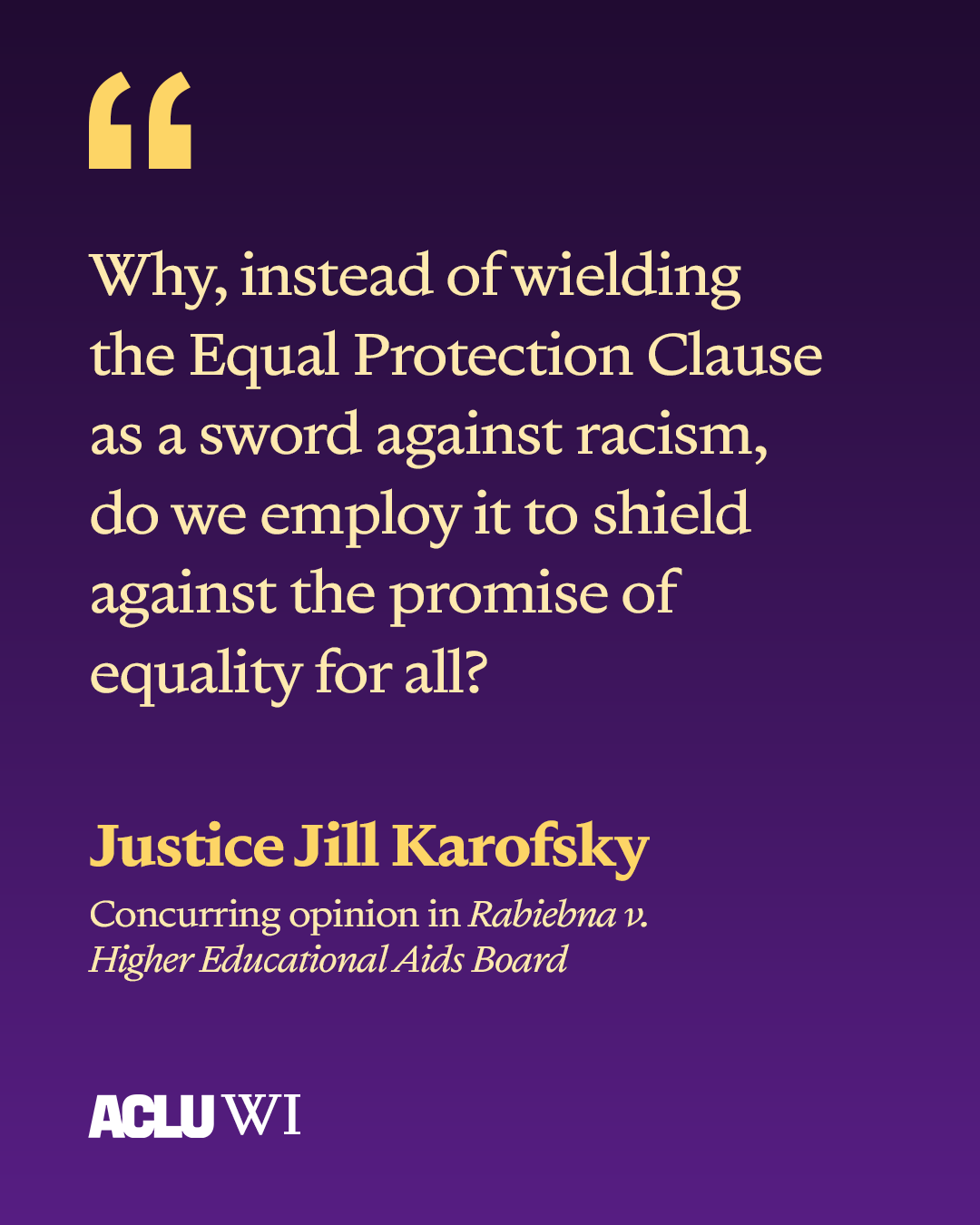
Justice Jill Karofsky (joined by Justice Susan Crawford) asked, “Why, instead of wielding the Equal Protection Clause as a sword against racism, do we employ it to shield against the promise of equality for all?” She argued that programs like the one at issue “could be constitutional under an interpretation of the Fourteenth Amendment that honors its purpose—to combat oppression.”
Justice Rebecca Dallet (joined by Justices Jill Karofsky and Susan Crawford) stated: “Rather than read the Equal Protection Clause consistent with its history and purpose of achieving racial equality, the Court has instead treated the Clause as a rule that entrenches inequality by prohibiting legislation designed to remedy it.” Optimistically, she wrote that “the result may be different for other laws with greater factual support.”
Fight for Racial Justice Continues
The “colorblind” ideology of SCOTUS is infuriatingly hypocritical. This is the same court that greenlit racial profiling and eviscerated Section 2 of the Voting Rights Act.
In the backlash to the Black Lives Matter movement, it can feel hopeless as progress is rolled back and colorblind racism makes strides. But the ACLU exists because the power of the U.S. government and the Supreme Court is not total. We the people are always resisting abuses and fighting back.
The legacies of slavery, discrimination, and racism will continue to impact our communities and haunt the United States until there is a real reckoning. We must continue to rally until the police brutality ends, the detention camps are closed, and real accountability and healing can take place.