
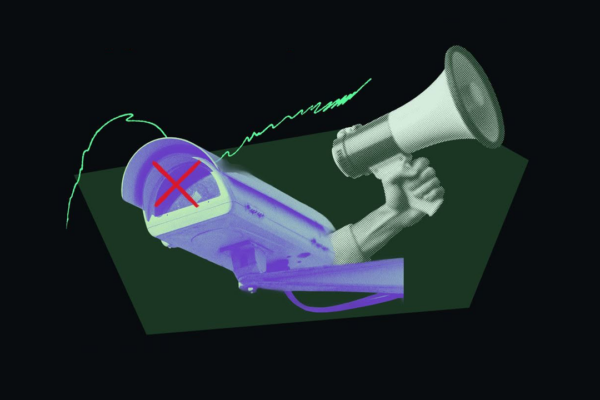

If you've paid attention to policing over the last decade, you've probably noticed that local police departments have quietly transformed into something that looks much closer to a miniature NSA than the neighborhood departments most Americans imagine.
As surveillance technologies become cheaper and easier to deploy, police departments continue purchasing them while local legislatures, state legislatures, and Congress struggle to keep pace. At the same time, private companies have built billion-dollar businesses around convincing governments that more surveillance automatically means more public safety.
Flock Safety is one of the clearest examples of this trend. The company has rapidly expanded across the country by selling automated license plate reader systems to local governments, backed by investors who see surveillance technology as an enormous growth industry.
As these systems continue to spread into cities and counties, it's easy to look at where things are headed and conclude that the surveillance state is simply inevitable. I understand why people feel that way.
But accepting that conclusion guarantees the very outcome we fear. If we decide these technologies can't be stopped, then we stop trying to stop them.
Fortunately, the last year in Wisconsin has demonstrated that organized communities can still influence surveillance policy.
Wave of Surveillance Tech
Local law enforcement has access to technologies that allow them to collect extraordinary amounts of information about ordinary people, often with very little public awareness. Unlike federal intelligence agencies, however, these technologies aren't operating somewhere far away in Washington. They're sitting in our own cities and counties.
Many departments now use cell site simulators, often called Stingrays, that impersonate cell towers and force every nearby phone to connect, whether or not the owner is suspected of a crime. Others purchase software that scrapes social media accounts for enormous amounts of personal information. Many have access to facial recognition systems connected to growing networks of public and private cameras that attempt to identify people as they move throughout their communities. On top of all of that, fusion centers combine information from these different surveillance systems into centralized databases where software, and increasingly artificial intelligence, can analyze thousands of records in seconds.
This isn't science fiction. It's happening here in Wisconsin.
The Milwaukee Police Department already possesses many of these technologies. So do countless other departments across the state. In many cases, these systems operate with minimal transparency, limited public oversight, and few meaningful audits to ensure they are used appropriately.
What is Flock?
Flock markets its cameras as simple license plate readers, but that description leaves out what actually makes the technology controversial. These systems don't just record a license plate number. They catalog the make and model of a vehicle, its color, visible damage, bumper stickers, roof racks, and other identifying characteristics. Depending on the system, they can also identify information about occupants inside the vehicle. Individually, none of that sounds particularly alarming. The problem is what happens when millions of those observations are collected and stored over time.
Instead of identifying a vehicle once, these systems build a searchable history of its travel. Law enforcement can reconstruct someone's movements across days, months, or even years, regardless of whether that person has ever been accused of committing a crime. That means they can identify where someone works, where they attend religious services, what doctor they visit, whether they drove to an abortion clinic, whether they regularly visit a gun range, who they spend time with, and countless other details about their private lives. The concern has never been that police can locate suspects. The concern is that these systems collect information on everyone first and determine later whether that information becomes useful.
If that sounds like an exaggeration, we already have real-world examples showing how extensive this surveillance can become.
In Norfolk, Virginia, retired Navy veteran Lee Schmidt requested records showing how often Flock cameras had captured his vehicle. Schmidt wasn't under investigation. He wasn't accused of committing a crime. During just four months in 2025, however, his vehicle had been logged by the camera network 475 different times. That means the system had quietly created hundreds of records documenting where an innocent person had traveled without him ever knowing it.
There's no reason to assume the same thing isn't happening here.
In August 2025, Wisconsin Examiner reporter Isiah Holmes documented that at least 200 law enforcement agencies across Wisconsin were using Flock Safety cameras. Two hundred departments connected to the same private surveillance company means millions of vehicle records are potentially being collected throughout the state. While we don't know how many times any individual Wisconsin resident has been captured by these systems, we know enough to ask serious questions about the scale of this surveillance.
We also know these concerns aren't hypothetical. Wisconsin has already seen documented and alleged cases involving the misuse of automated license plate reader systems in communities including Milwaukee, Racine, Kenosha, and Oshkosh. Every time a technology capable of tracking innocent people is deployed without strong oversight, abuse becomes a matter of when rather than if.
Local Wins Against Flock
Local residents, civil liberties advocates, students, conservatives concerned about government overreach, progressives worried about privacy, and ordinary people who simply don't want to be constantly tracked have successfully pressured elected officials to rethink whether these systems belong in their communities.
The strongest example of that movement has been the growing opposition to Flock Safety's automated license plate readers.
Dane County voted 32 to 1 to eliminate funding for the Sheriff's Flock contract, effectively ending the county's participation in the system. Verona declined to renew its contract and eventually removed its cameras altogether. Oshkosh reversed course after city officials concluded that Flock had allegedly misrepresented aspects of its technology. Monona ended its contract. Fitchburg voted unanimously to discontinue its agreement. Appleton announced it would stop using Flock. Sturgeon Bay also walked away from the system. Most recently, the University of Wisconsin–Madison Police Department chose not to renew its Flock contract and has begun removing its cameras from campus.
Viewed individually, each of these decisions might seem relatively small. Viewed together, they tell a very different story. They demonstrate that communities are capable of slowing the expansion of surveillance technology when residents pay attention, organize, and hold their elected officials accountable. They also show that concerns about privacy aren't confined to one political party. Opposition has come from people with very different ideologies who all recognize that giving governments the ability to monitor innocent people at this scale carries enormous risks.
At the same time, we shouldn't confuse these victories with the end of the conversation. Replacing Flock with another automated license plate reader company like Motorola Solutions or Axon doesn't solve the underlying problem. The issue isn't simply which corporation owns the cameras. The issue is whether governments should be deploying technologies specifically designed to create mass databases documenting the movements of innocent Americans. Changing vendors while keeping the same surveillance practices doesn't meaningfully address that concern.
The same principle extends beyond automated license plate readers. Wisconsin has also seen successful organizing around facial recognition technology. Community pressure helped push back against facial recognition contracts involving both the Milwaukee Police Department and the Milwaukee County Sheriff's Office. Those victories deserve just as much attention because they remind us that surveillance isn't one isolated technology. It's an interconnected ecosystem where cameras, facial recognition, license plate readers, social media monitoring, and other databases become increasingly powerful when linked together.
Don’t Stop Fighting
Perhaps the most important lesson from the past year is that democracy still works when people are willing to participate in it.
Wisconsin doesn't have kings. America doesn't have kings. Every city council member, county supervisor, sheriff, mayor, state legislator, governor, member of Congress, and president ultimately answers to the public. Police departments don't purchase surveillance technology on their own. Contracts are approved by elected officials. Budgets are approved by elected officials. Policies governing how these technologies are used are written by elected officials. If those officials decide to prioritize convenience over civil liberties, it's our responsibility to remind them who they work for.
That's why these recent victories deserve to be celebrated. Not because they solved the broader problem of mass surveillance, but because they prove that ordinary people still have the power to influence public policy. Every contract that wasn't renewed, every camera that came down, and every vote that rejected another expansion of Flock happened because residents refused to accept that constant surveillance was simply the cost of living in a modern society.
The surveillance state isn't expanding because it's unstoppable. It's expanding because too many decisions are made without public attention. The good news is that the opposite is also true. When communities pay attention, ask difficult questions, demand transparency, and organize together, they can change those decisions.
Wisconsin has spent the last year proving exactly that. My hope is that the rest of the country starts paying attention.