Do you know the first surveillance laws in the United States?
They weren’t facial recognition algorithms or license plate readers. They were Lantern Laws, passed in 1712 New York City and later replicated across the country. These laws forced Black, mixed-race, and Indigenous people to carry lanterns next to their faces when walking at night unless escorted by a white person. The laws also deputized any white person to stop, question, and detain Black people they deemed suspicious or noncompliant. Punishment could include public lashings.
The purpose was simple: to know the whereabouts of Black and Indigenous people at all times and to create an omnipresent force of white supremacy through surveillance. These laws later expanded to forbid Black people from gathering in groups after dark, including for funerals and celebrations, out of fear that such gatherings could lead to organizing, resistance, or rebellion.
This wasn’t about safety. It was about ensuring Black people could never move freely, never escape supervision, and never exist outside the gaze of white authority.
Do you see the through line?
Surveillance in the United States was never designed for public safety or justice. It was designed to be weaponized to enforce white supremacy and protect the status quo. White supremacy and disproportionate targeting isn’t a flaw in the system. That is the point.
When we stop viewing state surveillance through the lens of crime prevention and instead see it as a system designed to uphold white supremacy, American surveillance finally makes sense. The over-surveillance of Black Americans is not a policy failure or correctable mistake. The surveillance of Black bodies is the intended outcome.
Black people are not monitored more by accident. The state deliberately aims its tools at them: ShotSpotter being placed almost entirely in Black neighborhoods in cities like Milwaukee, Washington, D.C., and Chicago, or facial recognition technology being used disproportionately to identify and criminalize Black faces.
Are the Lantern Laws really that different from stop-and-frisk or from the killing of Trayvon Martin? In each case, white people are empowered to assume Black guilt first and Black people are forced to prove their innocence just to exist in public.
Under the American surveillance state, the Black body is treated as inherently criminal because free and autonomous Black people threaten the white supremacist infrastructure this system was built to protect.
If autonomous Black individuals are dangerous to this system, collective Black political action is terrifying. That is why the Lantern Laws banned Black gatherings in unsupervised spaces. The fear was never crime; it was organizing and Black collective resistance. Surveillance in America has always been used to prevent Black communities from coming together, building power, and resisting their own subjugation.
J. Edgar Hoover said it plainly: “The Black Panther Party represents the greatest threat to the internal security of the country.”
The FBI responded by unleashing COINTELPRO: weaponizing federal and local surveillance to infiltrate, sabotage, and destroy Black liberation movements throughout the 1960s and 70s. This wasn’t “bad policing” or a “rogue actor,”; it was confirmation that policing Black autonomy and suppressing Black liberation are core functions of the American surveillance state.
We saw this in Milwaukee.
Just as the FBI surveilled the Civil Rights Movement, the Black Panthers and Black leaders like Martin Luther King Jr. and Fred Hampton, Police Chief Harold Breier and the Milwaukee Police Department invested enormous resources into surveilling local Black Panther chapters, the NAACP Youth Council, and leaders like Vel Phillips.
Wouldn’t these resources be better used to stop crime? That depends on the goal of surveillance. If the goal of surveillance were public safety, these choices would be irrational but if the goal was protecting white supremacy and crushing dissent, they made perfect sense.
Black Lives Matter exposed this pattern again.
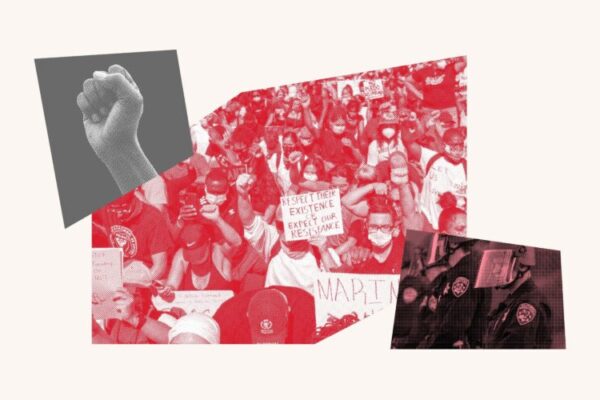
Despite no ties to organized crime, BLM became one of the most heavily surveilled political movements in modern history. Law enforcement weaponized the surveillance state not to fight violence or crime, but to respond to Black organizing. The Brennan Center uncovered 700,000 pages showing how federal and local law enforcement coordinated surveillance of BLM activists.
In Wisconsin, local police departments like Milwaukee, Wauwatosa and Kenosha PD coordinated with the FBI to surveil the Black Lives Matter movement in the state. They used drones, cellphone seizures, and protester databases to track activists. Wauwatosa police cataloged over 190 activists, journalists, and elected officials. These databases weren’t about preventing crime but people who organized to challenge the status quo.
Surveillance in the United States has always followed the same pattern: it is built and designed for Black communities and then expanded to everyone else.
The same logic that justified lantern laws justified COINTELPRO. The same logic that justified the coordinated federal and local law enforcement spying in COINTELPRO justified the spying on Black Lives Matter. The lack of pushback and protections of civil liberties for Black Lives Matter activists justify data-sharing between local police, ICE, DHS, and private surveillance firms like Palantir to expand and target non-Black groups.
Because once surveillance of Black communities is tolerated and ignored, there is no limiting principle left. The infrastructure is already in place. The targets simply expand to immigrants, abortion seekers, queer and trans people, journalists, and political dissenters who were not under this level of scrutiny a decade ago.
Black history is not just something to commemorate. It is a warning. The question is not whether surveillance will spread, but whether you will stop ignoring it before it comes for you.